
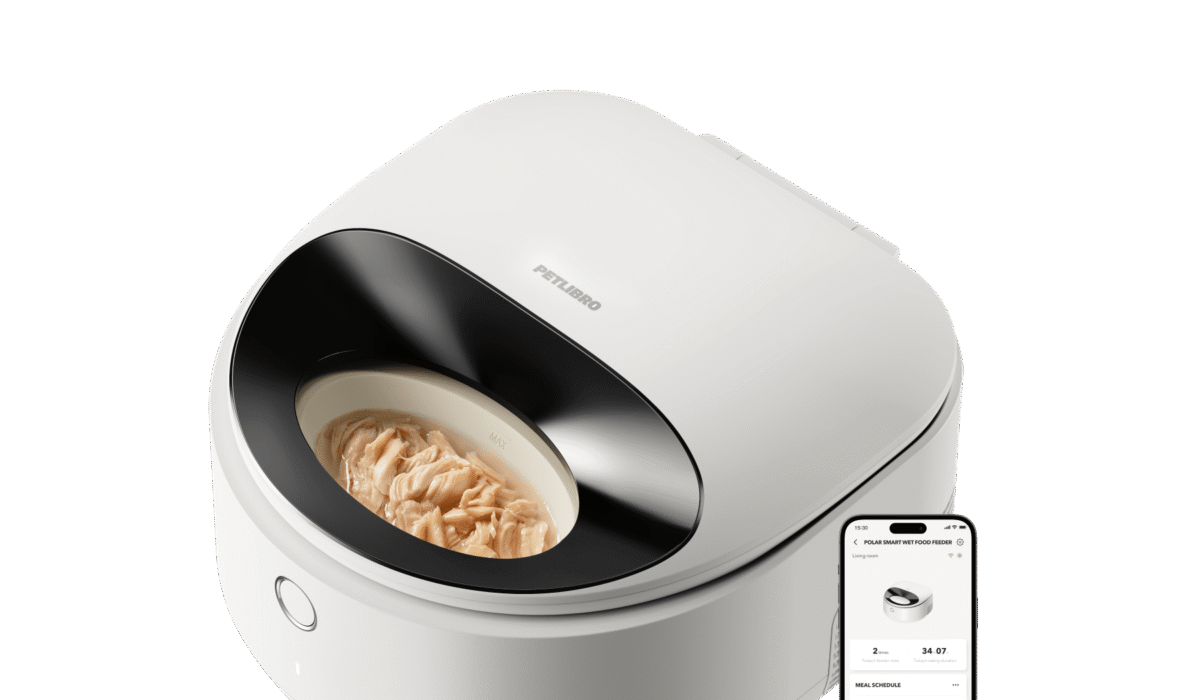
Refrigerated pet feeders solve a problem that dry-food hoppers cannot: they must hold pre-portioned moist food between meals and control when a pet can reach it. The category is still small, and the word refrigerated can hide major differences in actual temperature, food compatibility, meal count, and outage behavior.
1. Compare the stated temperature, not the marketing label
Two feeders can both advertise active cooling and still operate very differently. PetSafe FreshFeed currently states a 40°F target when used as directed. PETLIBRO Polar states that in a 77°F room its lab testing cooled food to around 54°F. Those numbers should not be treated as equivalent.
For buyers, the lesson is simple: look for the manufacturer’s temperature guidance and test conditions. A feeder that cools below room temperature may help preserve a meal, but it should not automatically be treated like a household refrigerator. Follow the food maker’s storage instructions and discard questionable food rather than relying on a product name.
2. Food compatibility is model-specific
Wet, fresh, raw, prescription, and semi-moist foods are not interchangeable categories. PetSafe explicitly lists raw and fresh diets among FreshFeed’s supported uses when the feeder is used correctly. PETLIBRO, by contrast, currently recommends avoiding raw food in Polar because of its perishability and variable shelf life.
If medication or supplements are mixed into a meal, verify that the feeder maker and veterinarian both consider that appropriate. Some feeder manufacturers specifically restrict medication use. A smart schedule should never create uncertainty around a medical dose.
3. Meal count changes the entire routine
Polar holds three pre-portioned meals. FreshFeed holds six. More positions can extend the time between loading cycles, but they also mean more food and more surfaces sitting in the appliance. Choose the smallest meal count that comfortably covers the routine rather than assuming more is always better.
Check compartment volume too. A “six-meal” feeder may still be unsuitable if each section cannot hold the pet’s normal portion. Conversely, a large compartment can make portion control harder if the owner simply fills it by eye.
4. Understand what happens before the meal opens
Some feeders intentionally reduce cooling just before serving so food is less cold. Polar pauses cooling for about 30 minutes before serving; FreshFeed pauses five minutes before serving and does not actively chill during mealtime. That can improve palatability, but it also means the temperature at the moment of eating is not the same as the storage target.
5. Power backup needs precise wording
Active cooling depends on electricity. A battery statement may refer only to the schedule, display, or door mechanism—not full refrigeration. Polar, for example, says AA backup batteries can continue the feeding schedule for 12 hours during a power outage. That should not be interpreted as a promise that the batteries maintain normal cooling.
For any refrigerated feeder, decide in advance what you will do after a prolonged outage. If the home loses power while nobody is present, the owner needs a conservative food-safety rule, not hope that the app will solve it.
6. Cleaning design matters every day
Removable stainless-steel inserts or bowls are easier to wash thoroughly than complicated fixed food wells. FreshFeed uses dishwasher-safe stainless inserts; current Polar versions offer a dishwasher-safe stainless bowl. Also inspect how easily condensation, food residue, and moisture can be removed from the cooling cavity, lid edge, and tray seat.
Refrigeration slows microbial growth; it does not eliminate the need to wash the feeder. Build cleaning into the refill routine so there is never pressure to load new food onto yesterday’s residue.
7. App features should support the feeding plan, not define it
Remote scheduling, meal notifications, and manual opening can be useful, but the essential question is whether the feeder still executes its saved plan reliably if the internet connection is interrupted. Also check whether the app requires a subscription. FreshFeed currently does not; hardware in other smart-pet categories often does.
8. Check the pet’s physical fit
Feeder height and opening geometry matter for kittens, flat-faced pets, or animals with neck/mobility limitations. PETLIBRO recommends a shoulder height of at least 6.1 inches for comfortable Polar use. An adult cat that eats comfortably from a raised bowl may have no issue; a tiny kitten might.
Quick comparison: Polar vs FreshFeed
| Feature | PETLIBRO Polar | PetSafe FreshFeed |
|---|---|---|
| Meal positions | 3 | 6 |
| Current temperature statement | About 54°F at 77°F ambient in PETLIBRO lab testing | 40°F target when used as directed |
| Raw food | PETLIBRO recommends avoiding | PetSafe lists raw/fresh support when used as directed |
| Serving warm-up behavior | Cooling pauses about 30 minutes before serving | Cooling pauses 5 minutes before serving and during mealtime |
| Subscription | Core feeder app functions do not need a separate care plan for basic scheduling | No subscription required |
Bottom line
Choose a refrigerated feeder from the pet’s diet outward: food safety requirement, meal size, number of meals, outage plan, cleaning routine, and only then app convenience. If a manufacturer does not clearly state what its cooling system does, that uncertainty should count against the product rather than being filled with assumptions.
Questions readers ask
Are all refrigerated pet feeders kept at 40°F?
No. Current products use different cooling designs and state different operating temperatures. Check the exact manufacturer specification and test conditions.
Can I use raw pet food in a refrigerated feeder?
Only if the specific manufacturer supports it and the food is handled according to safe storage guidance. PETLIBRO currently recommends avoiding raw food in Polar, while PetSafe lists raw/fresh use for FreshFeed when used as directed.
What happens during a power outage?
It varies. Some battery backups may preserve scheduling rather than refrigeration. Treat a long outage as a food-safety event and follow the manufacturer’s current guidance.
Is a refrigerated feeder useful for dry food?
Usually not. Dry-food hopper feeders are simpler, cheaper, and offer larger capacity when refrigeration is unnecessary.