
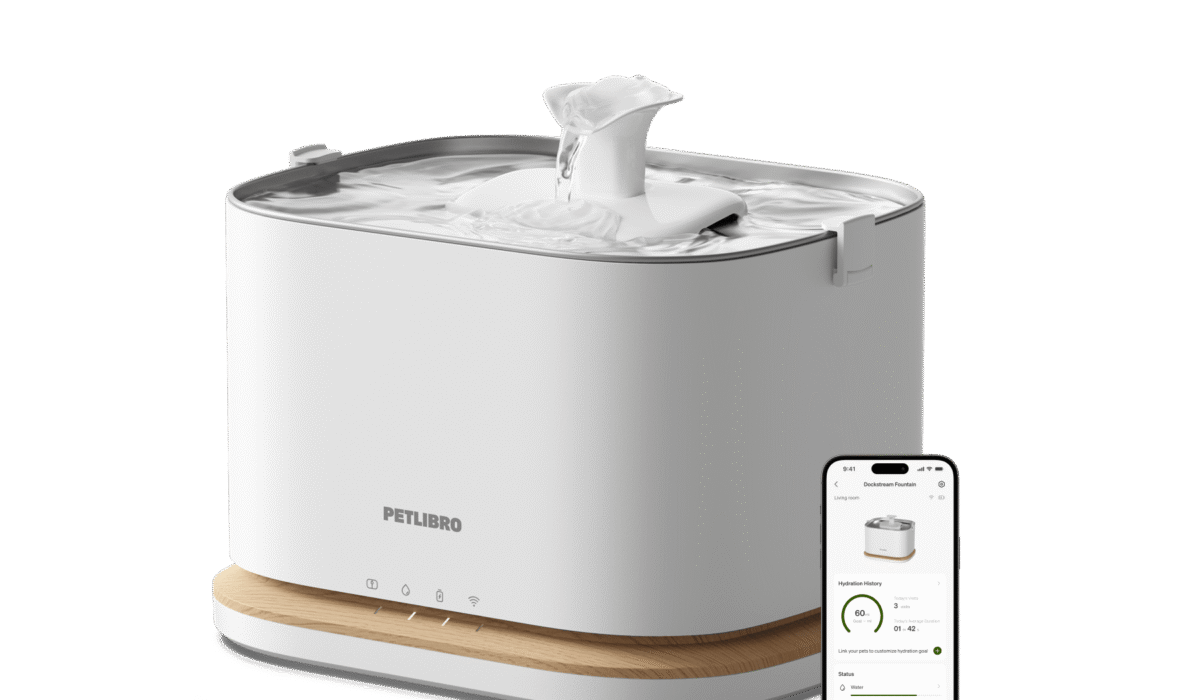
A smart fountain is still a water bowl with moving parts. Before comparing hydration graphs, first ask whether the reservoir is large enough, the surfaces are easy to clean, replacement filters are affordable, and the pet will actually drink from it.
1. Match reservoir capacity to the household
Capacity affects both convenience and water freshness. Petcube Fountain holds 1.7 L / 57 oz, while PETLIBRO Dockstream RFID holds 3 L / roughly 101 oz. The smaller tank can be comfortable for one cat; a multi-cat household may appreciate the larger reservoir even if it is refilled before empty.
Do not use capacity to justify leaving water untouched for long periods. Refilling and washing on a routine is better than waiting until a very large tank is nearly dry.
2. Decide whether you need appliance monitoring or pet identification
Smart features fall into two different groups. Some fountains monitor the appliance: water level, filter life, maintenance reminders. Other systems try to monitor the animal. Dockstream RFID uses PETLIBRO collar tags to attribute drinking sessions to individual pets and can track up to five tagged animals.
That is valuable when one cat’s drinking pattern needs to be separated from the others. But it is not implanted-microchip recognition; a cat must wear the compatible RFID tag. If all you want is a low-water alert, paying for identification hardware may be unnecessary.
3. App independence is a reliability advantage
Petcube states that its Fountain can operate without internet, Bluetooth, or Wi-Fi; the app adds reminders and status information. That is a strong design principle for a water source. If a router fails, the pet should not lose access to moving water.
For any connected fountain, ask what still works when the app, router, or cloud service is unavailable. The answer should be clear before purchase.
4. Filter replacement is a recurring cost
PETLIBRO currently recommends replacing the Dockstream RFID filter every two weeks. Petcube recommends every four weeks for its Fountain. Water hardness, hair, dust, and the number of pets can change how quickly a filter looks dirty, but the stated schedule gives buyers a useful starting point for yearly replacement cost.
Buy replacement filters only from a source you trust and verify that the part number matches the exact fountain generation. A fountain that is cheap today can become expensive if proprietary filters are frequent or hard to find.
5. “Pump-free” and “wireless pump” do not mean maintenance-free
Modern fountains increasingly separate powered components from the removable water tank, sometimes describing the design as pump-free, wireless, or magnetic. That can make disassembly easier and reduce submerged wires, but the rotor, spout, channels, basin, and seams still collect residue.
Evaluate how many pieces must be taken apart, whether the drinking surface is dishwasher-safe, and whether a small brush can reach the water path. A fountain that takes 20 minutes to clean may be neglected more often than one that comes apart in two minutes.
6. Stainless steel and ceramic have practical advantages
Both are smoother, durable drinking surfaces when properly maintained. Petcube offers stainless and ceramic upper-tray variants, and PETLIBRO Dockstream uses a stainless drinking area. Material does not eliminate biofilm, but an easy-to-scrub surface is preferable to complex textured plastic where residue can hide.
7. Hydration data is a trend, not a diagnosis
A meaningful increase or decrease in drinking can be medically important, especially in cats. Smart-fountain data can help an owner notice a change, but it cannot explain why it happened. If a pet suddenly drinks much more, much less, stops urinating normally, loses weight, vomits, or appears unwell, contact a veterinarian rather than trying to diagnose from an app chart.
8. Always provide a backup water source
Pumps fail, batteries discharge, filters clog, and curious pets can move a fountain. Keep another clean bowl available, especially when the pet will be alone. A low-water notification is useful; it should not be the only protection against dehydration.
Petcube vs Dockstream RFID: different smart priorities
| Feature | Petcube Fountain | PETLIBRO Dockstream RFID |
|---|---|---|
| Capacity | 1.7 L / 57 oz | 3 L / about 101 oz |
| Core operation without internet | Yes, per Petcube | Fountain water function is separate from analytics, but RFID/app features depend on correct setup |
| Individual-pet tracking | No RFID attribution | Up to five PETLIBRO-tagged pets |
| Filter guidance | About every 4 weeks | About every 2 weeks |
| Best use | Compact general fountain with optional smart reminders | Multi-cat hydration attribution |
Bottom line
Buy the fountain whose maintenance routine you will actually follow. Capacity, cleanability, replacement-filter supply, app independence, and pet acceptance are more important than a long feature list. Individual hydration tracking is worthwhile when it solves a real multi-pet problem; otherwise a simpler fountain can be the smarter purchase.
Questions readers ask
Do smart fountains measure exactly how much a pet drinks?
Some estimate intake from sensors and events; accuracy depends on design and correct setup. Treat the data as a useful trend rather than a medical measurement.
How often should fountain filters be changed?
Follow the exact manufacturer schedule. Current examples differ: PETLIBRO recommends about two weeks for Dockstream RFID, while Petcube recommends about four weeks for its Fountain.
Does a smart fountain need Wi-Fi to provide water?
It depends on the product. Petcube explicitly says its Fountain operates without internet/Wi-Fi; connected monitoring features require the app.
Should I still leave a normal bowl out?
Yes, especially when the pet is alone. A backup clean water source protects against pump, battery, clogging, or setup failures.