
PetSafe Smart Feed Automatic Pet Feeder, 2nd Generation
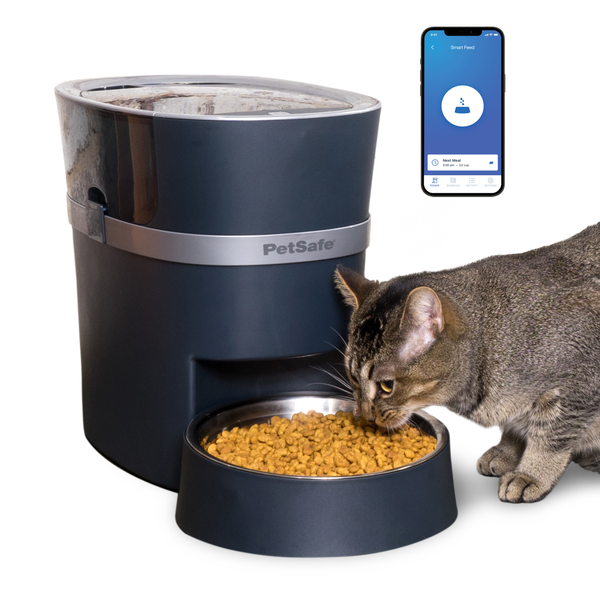
PetSafe
Smart Feed 2nd Generation remains a strong dry-food automation choice because the core feeding controls are practical: 24 cups, 12 schedules, 1/8-to-4-cup portions, and a real Slow Feed mode. It is not a wet-food solution, and the connected setup is only worthwhile if the household will use the app and alerts.
What we like
- 24-cup hopper
- Up to 12 scheduled meals per day
- Portions from 1/8 cup to 4 cups
- Slow Feed dispenses meals over 15 minutes
- Low/empty food alerts
- Feed Now available in the app and from a pet-resistant button
- Optional battery backup
What to consider
- Dry or semi-moist food only
- 2.4 GHz Wi-Fi required
- Large footprint compared with simple rotating feeders
- Portion accuracy still depends on kibble shape and flow
- Connected features add setup complexity
Product snapshot
| Capacity | 24 cups / about 6 L |
|---|---|
| Meals | up to 12 per day |
| Portion range | 1/8 cup to 4 cups per meal |
| Slow Feed | meals larger than 1/8 cup dispensed gradually over 15 minutes |
| Food | dry or semi-moist |
| Connectivity | 2.4 GHz Wi-Fi |
| Control | My PetSafe app; Feed Now button on feeder |
| Alerts | low-food and empty-hopper notifications |
| Power | wall adapter; optional 4 D-cell battery backup |
| Care | lid, hopper, bowl, and bowl holder are dishwasher-safe per PetSafe |
A large smart hopper rather than a rotating tray
PetSafe Smart Feed 2nd Generation is built for dry and compatible semi-moist food. The hopper holds 24 cups and a conveyor meters portions into a stainless bowl. That makes it better suited to longer routine use than a five- or six-section tray that must be manually reloaded after every cycle.
PetSafe allows up to 12 scheduled meals each day, with portion settings from 1/8 cup to 4 cups. Those are broad limits, but the number on an app is not the same thing as laboratory-scale precision. Kibble diameter, shape, density, and how freely it moves through the feeder can affect the amount that actually reaches the bowl. Owners should measure several dispenses with their own food before relying on a programmed portion.
Slow Feed is more than a marketing toggle
For meals larger than 1/8 cup, Slow Feed can spread dispensing over 15 minutes. That can help a pet that gulps food too quickly by preventing the full portion from appearing at once. It is not a substitute for veterinary advice about vomiting, swallowing problems, or medical feeding, but it is a genuinely useful mechanical feature for routine pace control.
App control and useful failure alerts
The My PetSafe app handles the schedule and remote Feed Now control. Sensors report when the hopper is low or empty, which is more useful than a smart feeder that quietly keeps executing an empty schedule. A physical pet-resistant Feed Now button on the top also means an owner at home can dispense without opening the phone.
The feeder requires a 2.4 GHz Wi-Fi network for connected features. Dual-band routers usually support that, but onboarding can be awkward if the router hides or aggressively combines the bands. It is worth checking the home network before buying rather than diagnosing Wi-Fi after the hopper is full.
Power backup is for resilience, not refrigeration
The normal power source is the wall adapter, with four D-cell batteries available as backup. Because this is a dry-food feeder, a power interruption is primarily a scheduling problem rather than a refrigeration problem. The batteries can keep feeding more resilient during an outage, but owners should still verify the feeder after any long interruption.
Cleaning and kibble compatibility
PetSafe lists the lid, hopper, bowl, and bowl holder as dishwasher-safe. The conveyor path deserves inspection too, particularly with oily or crumb-prone food. Semi-moist food is supported, but very sticky pieces can create more residue than standard kibble.
Before leaving the feeder unattended for the first time, run several meals using the exact food the pet will eat. Confirm that the portion reaches the bowl, the pet cannot force the lid, the alert notifications arrive, and the feeder sits somewhere it cannot be tipped or blocked.
When Smart Feed is the better choice
Choose Smart Feed when the pet eats dry food and the priority is many scheduled portions from a large reservoir. If the pet eats wet food, comparing it with Polar or FreshFeed is misleading: those products solve food-temperature problems that this hopper is not designed to address. Smart Feed wins on dry-food capacity and portion flexibility, while refrigerated feeders win on food type.
PetSafe Smart Feed Automatic Pet Feeder, 2nd Generation FAQs
How many meals can PetSafe Smart Feed schedule?
Up to 12 meals per day.
What portion sizes can it dispense?
PetSafe lists 1/8 cup through 4 cups per meal. Test the actual output with your pet’s kibble because food shape and density can affect the delivered amount.
What does Slow Feed do?
For meals larger than 1/8 cup, Slow Feed dispenses the meal in smaller amounts over 15 minutes.
Does it work with wet food?
No. PetSafe specifies dry or semi-moist food; wet-food diets need a different feeder design.
Related reviews and buying guides
Community experience