
PETLIBRO Dockstream RFID Smart Fountain
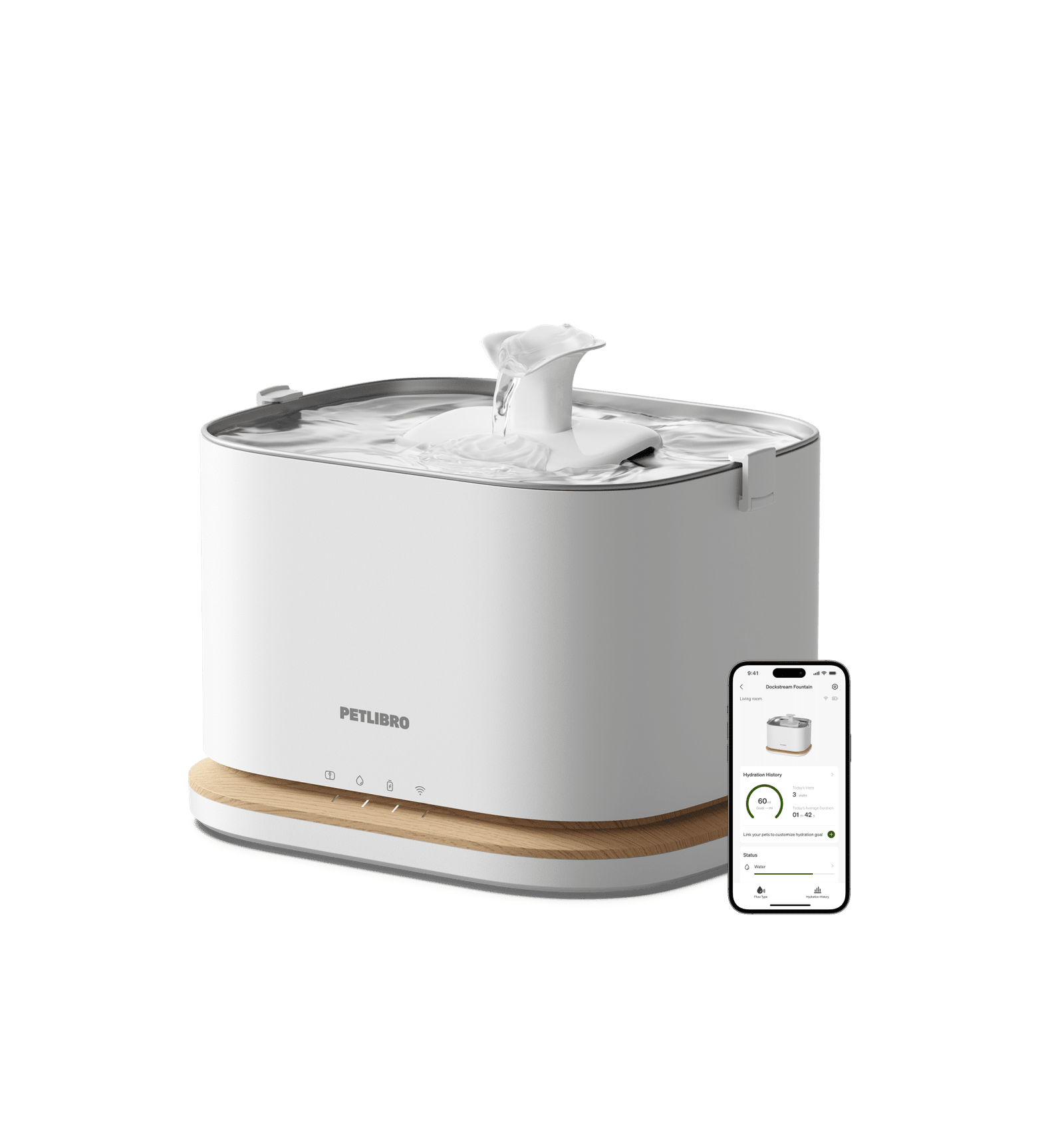
PETLIBRO
Dockstream RFID adds something most smart fountains cannot: it can attribute drinking sessions to individual cats. That is genuinely useful in a multi-cat home, but only if the cats will reliably wear PETLIBRO’s RFID tags and the owner is willing to maintain the fountain and tracking setup.
What we like
- Tracks drinking sessions for up to five tagged cats
- 3 L / about 101 oz capacity
- Includes two RFID collar tags
- App records amount, frequency, and duration of drinking
- Detachable tank and quiet water-moving system simplify everyday handling
What to consider
- Does not read implanted microchips
- Per-pet tracking depends on PETLIBRO RFID tags
- 2.4 GHz Wi-Fi only
- Filter replacement is recommended every two weeks
- Accurate attribution depends on correct calibration and the splash guard setup
Product snapshot
| Model | PLWF305 |
|---|---|
| Capacity | 3 L / about 101 oz |
| Tracking | up to 5 pets with compatible PETLIBRO RFID tags |
| Included tags | 2 |
| Material | ABS and stainless steel |
| Dimensions | 9.6 × 7.9 × 9.1 in |
| Connectivity | 2.4 GHz Wi-Fi |
| Power | corded electric |
| Noise claim | about 23 dB |
| Recommended filter replacement | every 2 weeks |
| Best suited by manufacturer to cats, then small dogs | |
The useful part is attribution, not just an app
A normal connected fountain can tell an owner that water was consumed, but in a house with three cats that may not answer the important question: which cat drank? PETLIBRO’s Dockstream RFID Smart Fountain pairs drinking events with the company’s collar tags so the app can log amount, frequency, and duration for individual animals. PETLIBRO says the system can track up to five pets and includes two tags in the standard box.
That makes the RFID model most valuable in multi-cat households. If there is only one cat, the extra recognition hardware may add complexity without providing much more practical information than a simpler smart fountain.
RFID here does not mean a veterinary microchip
The recognition system is proprietary. The fountain does not read the implanted identification microchip a veterinarian may have placed under a cat’s skin, and PETLIBRO says third-party tags are not supported. The cat has to wear a compatible PETLIBRO collar tag for its drinking events to be identified.
That is the biggest pre-purchase question. Cats that already wear a breakaway collar may adapt easily; cats that refuse collars eliminate the main reason to buy this version. PETLIBRO uses a snap-release collar setup, but owners still need to choose a safe fit and inspect the collar regularly.
Capacity and everyday fountain use
The reservoir holds 3 liters, roughly 101 fluid ounces. PETLIBRO describes it as best suited to cats and then small dogs, with a different fountain recommended for medium and large dogs. The stainless drinking area is a practical surface for routine washing, while the app can warn about low water and filter life.
The product page describes a detachable tank with a “pump-free” design. PETLIBRO’s support material also shows that a removable rotor and related components sit inside the tank. The useful takeaway is not the marketing label; it is that the removable water section is designed to separate cleanly from the powered base. The water path still needs physical cleaning, and a smart fountain can still develop slime or biofilm if bowls, seams, rotor parts, filters, and channels are neglected.
Tracking accuracy depends on setup
Per-pet data is only useful when the fountain is calibrated and assembled as instructed. PETLIBRO tells owners to perform weight calibration, and its RFID version uses a splash guard as part of the controlled drinking position. If the guard is removed or multiple pets drink in an unusual way, the neatness of the data can suffer.
The fountain connects on 2.4 GHz Wi-Fi, not 5 GHz. That is usually manageable on a dual-band home router, but it can be frustrating on networks that do not expose a compatible band during setup.
Recurring maintenance matters
PETLIBRO currently recommends replacing the filter about every two weeks. That is more frequent than some competing fountains, so filter availability and recurring cost belong in the buying decision. Filters also do not replace washing: refill with fresh water, inspect the drinking surface, and clean the parts on the schedule appropriate to the home and number of pets.
Who should consider Dockstream RFID
Buy the RFID version for the data problem it solves. It makes sense when two or more cats share a fountain and the owner wants a clearer picture of one cat’s drinking routine. It is less compelling if nobody needs individual attribution, if the cats will not wear tags, or if the goal is simply to provide circulating filtered water at the lowest possible cost.
PETLIBRO Dockstream RFID Smart Fountain FAQs
Can the Dockstream RFID fountain read my cat’s implanted microchip?
No. PETLIBRO says it uses compatible PETLIBRO RFID collar tags and does not support implanted microchips.
How many cats can it track?
PETLIBRO says up to five tagged pets can be tracked; the current package includes two RFID collar tags.
How often should I replace the filter?
PETLIBRO currently recommends replacement about every two weeks, alongside regular physical cleaning.
Does it support 5 GHz Wi-Fi?
No. The PLWF305 specification lists 2.4 GHz Wi-Fi.
Related reviews and buying guides
Community experience