
PetSafe SmartDoor Connected Pet Door
PetSafe
SmartDoor Connected is compelling when access control matters: the owner can schedule and authorize individual pets instead of leaving a flap open to any animal. The key buying detail is size-specific identification—Medium can use supported implanted microchips, while Large relies on Pet Door Keys—so choosing the opening is also choosing the access technology.
What we like
- App lock/unlock and schedules
- Selective access for approved pets
- Medium model can pair with supported implanted microchips
- Collar keys work for Medium and Large
- Battery status/door use notifications
- Optional power adapter with batteries available as backup
What to consider
- Permanent installation requires accurate cutting and placement
- Large model does not offer the same implanted-microchip support as Medium
- Metal, glass, wall, or thick-door installs can require extra accessories/pro help
- Each collar-key pet needs a compatible key
- More expensive and mechanically complex than a basic flap
Product snapshot
| Sizes | Medium and Large |
|---|---|
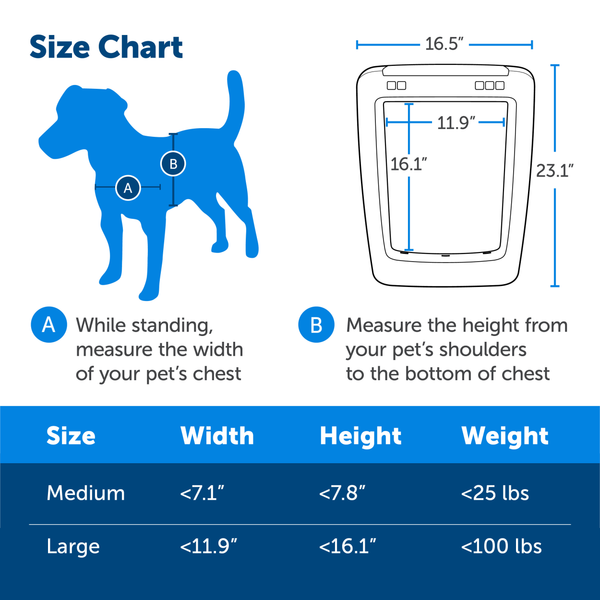
| Medium pet size | up to 25 lb; flap opening 7.1 × 7.8 in |
| Large pet size | up to 100 lb; flap opening 11.9 × 16.1 in |
| Identification | Pet Door Keys on both sizes |
| Microchips | Medium only; PetSafe lists FDX-B/15-digit, FDX-A/10-digit, AVID H, and AVID Encrypted/9 or 15 digit |
| Power | Medium uses 4 C-cell batteries; Large uses 4 D-cell batteries |
| Optional power adapter | available for both; batteries can remain for backup |
| Control | My PetSafe app with lock/unlock, schedules, permissions, notifications |
| Installation | cutout dimensions differ for metal and non-metal surfaces; accessories may be required for walls, metal, glass, or thick doors |
A smart pet door is really an access-control product
PetSafe SmartDoor Connected does more than open a flap. The My PetSafe app can lock or unlock the door, create schedules, set permissions, and report activity. Approved animals are recognized so the opening is not simply available to every neighborhood pet.
That makes the product useful for households that want a dog to access a fenced yard during certain hours, need different rules for multiple pets, or want more control over wildlife entering through a conventional flap.
Medium and Large do not use identification in exactly the same way
This is the most important detail in the review. Both sizes can use PetSafe Pet Door Keys attached to a collar. The Medium SmartDoor can also pair directly with certain implanted microchips. PetSafe lists FDX-B/15-digit, FDX-A/10-digit, AVID H, and AVID Encrypted/9 or 15-digit microchips. The Large SmartDoor does not offer that same implanted-microchip mode and relies on compatible collar keys for pet identification.
That means a cat owner who specifically wants keyless microchip entry should be evaluating the Medium model and the cat’s body fit at the same time. Do not buy the Large opening assuming “SmartDoor” automatically means microchip support.
Measure the pet before measuring the door
PetSafe rates Medium for pets up to 25 lb with a 7.1 × 7.8-inch flap opening, and Large for pets up to 100 lb with an 11.9 × 16.1-inch opening. Weight is only a starting point. Shoulder/chest width and comfortable step-over height determine whether the animal can use the opening without crouching or scraping.
Once the pet size is confirmed, measure the installation surface. Cutout dimensions differ for metal and non-metal doors, and walls, glass, metal, or thicker materials may need an installation adaptor, tunnel extension, or professional glazier/installer. The product is much less forgiving than a collar or feeder because a wrong cut remains in the building.
Power choices are more resilient than battery-only designs
The Medium model uses four C-cell batteries and the Large uses four D-cell batteries. PetSafe also sells a power adapter for both. When the adapter is used, batteries can remain installed as backup. That is a sensible arrangement for a device that controls physical access to the house.
Battery status belongs on a recurring maintenance checklist. A connected lock that has quietly lost power is not something an owner wants to discover after the pet has learned to depend on it.
Training matters as much as electronics
A cautious pet may not immediately push through a motorized or locking flap. Introduce the opening gradually, reward voluntary passage, and never force the animal through. Test the recognition range and schedule while someone is home before allowing unsupervised yard access.
Security has physical limits
The SmartDoor helps block unrecognized pets, but it is still a pet-sized opening cut into a door or wall. Home security, weather sealing, yard fencing, wildlife risk, and local conditions should be considered separately. A smart lock cannot make an unsafe outdoor space safe.
Who should choose it
SmartDoor Connected is best for an owner who genuinely needs controlled pet autonomy and is comfortable making a permanent installation. If the main requirement is simply “let the dog out sometimes,” a basic door costs much less. If the requirement is “this specific pet may enter/exit on this schedule and I want app control,” the connected model has a clear reason to exist.
PetSafe SmartDoor Connected Pet Door FAQs
Can PetSafe SmartDoor Connected read implanted microchips?
The Medium model can pair with supported microchips. PetSafe lists FDX-B/15-digit, FDX-A/10-digit, AVID H, and AVID Encrypted/9 or 15-digit. The Large model relies on compatible Pet Door Keys.
What size pets fit the SmartDoor?
PetSafe rates Medium for pets up to 25 lb and Large for pets up to 100 lb. Measure the pet’s actual width and step-over comfort, not weight alone.
Can it run from wall power?
Yes. PetSafe sells an optional power adapter for both sizes; batteries can remain installed as backup.
Can I install it in a metal door or wall?
Yes in many cases, but PetSafe specifies different cutouts and may require an installation adaptor and/or tunnel extensions. Glass installation for Medium should involve an appropriate professional.
Related reviews and buying guides
Category hub
Browse all Smart Pet Tech reviews →Related products
Community experience